# CSDIF Proof of Concept
## Community Science Data Interchange Format
---
<br/>
<br/>
<div style="float: right">
</div>
Matthijs Kooijman - MJS Amersfoort
Harmen Zijp - MJS Amersfoort
Egon Kastelijn - SMAL Zeist
Slides: https://md.giplt.nl/csdif-meetkoppel-2026
Website: https://www.csdif.info
Email newsletter: https://www.csdif.info/en/newsletter
Matrix chatroom: https://matrix.to/#/#csdif:matrix.org
Note:
- Sponsored by SpukSLA, Zeist, Amersfoort, Provincie Utrecht
---
# Collecting data
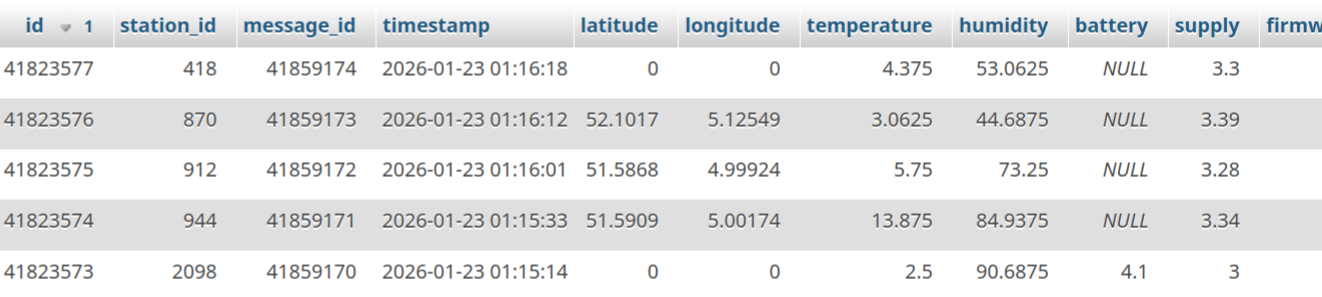
- Start with simple and fixed table: Time, temperature, humidity, position
- Adding fields (lux, battery, PM1, PM10, ...) does not scale
- Changing sensors loses metadata
- New experiments (tree circumference) do not really fit
- Exchange data!
Note:
- Familiar story for regulars: But now with progress
- Add lux, PM
- Different PM sensor, more fields, what sensor is used?
- Weird data, how is this sensor mounted exactly?
---
# What do we need?
Collect, store and expose observational data. Needs to:
- be flexible: handle different experiments
- have metadata: give meaning to data
- be standardized: support data exchange
Ideally also based on existing technologies and standards.
Note:
- SMAL Zeist handled "flexible" better from start (right Egon?)
- We tried building something ourselves from scratch, but hard choices...
---
# Introducing CSDIF
- Metastandard: Specifies how to use SensorThings and SensorML
- SensorThings for structure and API
- SensorML for metadata about stations and sensors
- <!-- .element: class="fragment" data-fragment-index="1" --> Based on Observations & Measurements conceptual model
- An *Observer* makes an of *Observation* (such as *Measurements*) of a *Property* of a *Feature* (something that is being observed).
- <!-- .element: class="fragment" data-fragment-index="2" --> Such as: *Observer* = meetstation-123, *Observation* = 15°C, *Property* = Temperature, *Feature* = Air inside this room
- <!-- .element: class="fragment" data-fragment-index="3" --> Or: *Observer* = Matthijs, *Observation* = "they look interested", *Property* = State of mind, *Feature* = People attending this talk
---
# Process
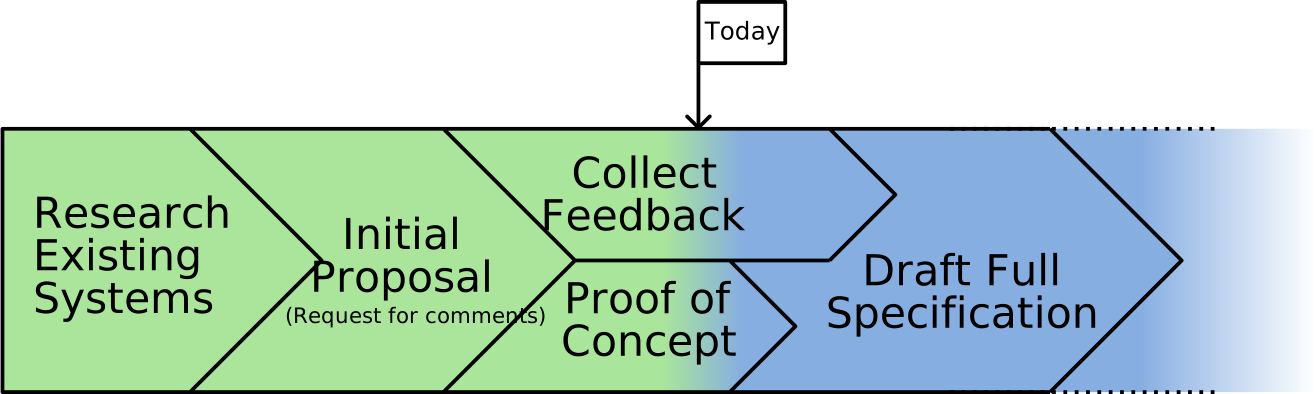
- 2023/2024: Explored various existing standards, selected SensorThings and SensorML as most promising
- 2024/2025: Wrote Request-For-Comments document outlining the goals and ingredients
- 2025 Built first proof-of-concept to explore ideas and technologies
- 2026+: Use PoC to answer open questions, solicit feedback, write CSDIF specification
---
# CSDIF Proof-of-concept
---
# PoC Parts
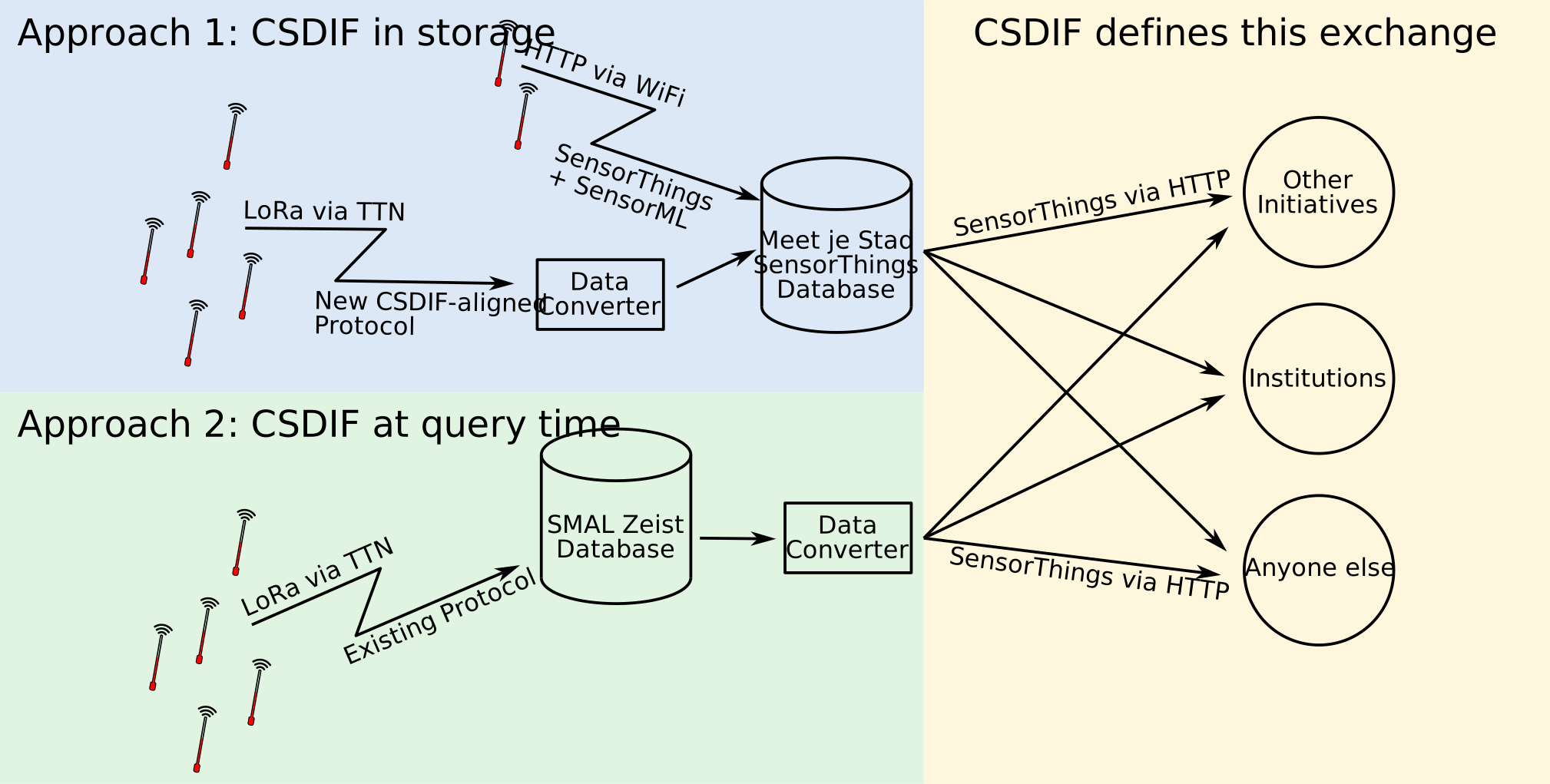
1. MJS: Use off-the-shelf SensorThings server for storage (FROST-Server)
- Now: Convert existing data before storage
- Later: Experiment with CSDIF-aware measurement stations
2. SMAL: Build custom SensorThings layer on existing storage
3. Interactive map to explore MJS and SMAL data
- Bonus: RIVM Samen Meten already uses SensorThings
Note:
- Samen Meten has limited metadata
- Next: Highlight experiences with PoC based around questions we wrote in the RFC or discovered in the PoC.
---
# Challenge: Complexity
- Unused model complexity
- Specification complexity
- Query / model complexity for own implementation
- Terminology complexity
- Solutions: Subset, documentation, examples
Note:
- Solutions are probably not perfect
---
# Challenge: Intended usecase
- RFC written for data exchange
- But realized storage and data access also important for adoption
- Needing three different databases raises barrier
- All three have subtly different requirements
- verbosity vs storage size
- query efficiency vs storage size vs processing power
- genericity vs low barrier to entry
---
# Challenge: Mapping existing data
- Stable Identifier generation
- Mapping queries onto existing data
- Data privacy and security
---
# Challenge: Flexibility
- SensorThings and SensorML are flexible by using arbitrary URLs
- to describe our stations:
```json
Identifiers = [
{
"definition":"http://sensorml.com/ont/swe/property/ModelNumber",
"label":"Model Number",
"value":"Si7021"
},
...
]
```
- to describe what is being measured:
```json
ObservedProperty = {
"definition":"http://qudt.org/vocab/quantitykind/Temperature",
"name":"Temperature",
"description":"Temperature",
}
```
- and a lot more
- Uses terms from externally defined "ontologies" (aka vocabularies).
---
# URLS are nice, but
- What ontologies to use?
- There are many
- Some old (used by examples, but no longer online)
- None of them complete
- Maybe start our own?
- How to further qualify? PM1 vs PM10? Air temperature vs water temperature?
- Experience welcome!
---
# Outcomes
- MJS CSDIF Data store
- Live at https://data-test.meetjestad.net/SensorThings/v1.1/
- Code at https://github.com/meetjestad/mjs_backend_design/tree/backend-prototype-frost-sta
- SMAL Zeist CSDIF Data converter
- Live at https://sensorthings-api.meten-natuurlijk.nl/sensorthings-api/SensorThingsService/v1.0
- Code at https://codeberg.org/Cooperatief-Meten-Natuurlijk-UA/sensorthings_api
- SensorThings API validator
- Code at https://codeberg.org/Cooperatief-Meten-Natuurlijk-UA/sensorthings-validator
- CSDIF standard development
- RFC at https://www.csdif.info/en/document-CSDIF-001-RFC
- PoC experiences at https://www.csdif.info/en/document-CSDIF-002-POC
---
# Next steps
- Use PoC for additional experiments
- CSDIF-aware measurement stations
- High-volume performance (10yr MJS data)
- Express additional metadata
- Find minimally required query features
- Translate PoC experiences into CSDIF spec
- Invite others (you!) to play with our APIs
- Spuksla done, but CSDIF part of:
- UTMOST project with KNMI
- FAIR Data Logger with University of Twente
---
# Thanks!
Website: https://www.csdif.info
Email newsletter: https://www.csdif.info/en/newsletter
Matrix chatroom: https://matrix.to/#/#csdif:matrix.org

Slides: https://md.giplt.nl/csdif-meetkoppel-2026
---
# Questions? Wishes? Suggestions?
Website: https://www.csdif.info
Email newsletter: https://www.csdif.info/en/newsletter
Matrix chatroom: https://matrix.to/#/#csdif:matrix.org

Slides: https://md.giplt.nl/csdif-meetkoppel-2026
{"tags":"presentation, meetkoppel-2026, csdif","type":"slide","lang":"en","title":"CSDIF Proof of Concept - Community Science Data Interchange Format","slideOptions":{"progress":true,"controls":true,"slidenumber":true,"width":1920,"height":1080}}